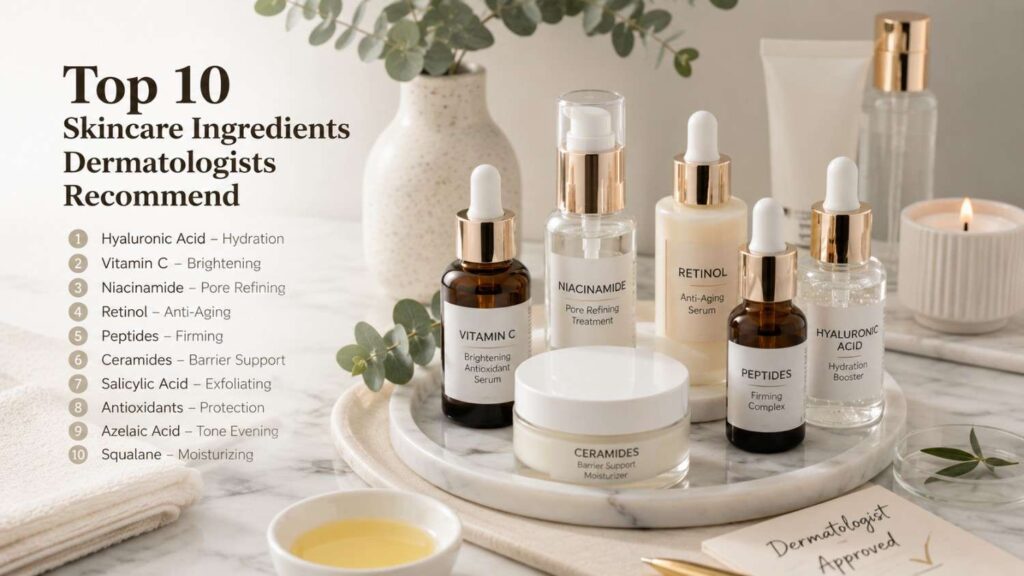
Top 10 Skincare Ingredients Dermatologists Recommend
Choosing skincare should not feel like guessing. Every year, new serums, creams, cleansers, and “must-have” actives appear online. Some are useful, some are overhyped, and some may not suit your skin at all. That is why dermatologist recommended skincare ingredients matter. They help you focus on ingredients with a clear purpose instead of following every new trend.
The Top 10 Skincare Ingredients Dermatologists Recommend are not random. They are widely used because they target real skin concerns such as acne, dryness, fine lines, uneven tone, clogged pores, sun damage, and a weak skin barrier. Each ingredient works differently, so the key is not to use everything. The key is to understand what your skin needs and choose the right ingredient for that goal.
This guide explains the best skincare ingredients in a practical way. You will learn what each ingredient does, who it is best for, how to use it, and what to avoid when building a routine. The article is written for beginners, but it also includes enough detail for readers who already understand skincare basics and want a more professional explanation.
How To Choose Dermatologist-Recommended Skincare Ingredients
Before choosing a product, it is important to understand that skincare ingredients are not one-size-fits-all. A strong ingredient can be helpful for one person and irritating for another. For example, salicylic acid may work well for oily, acne-prone skin, but it may dry out sensitive or already-dehydrated skin. Retinoids can help with acne, uneven texture, and fine lines, but they need to be introduced slowly because they can cause dryness and peeling.
A professional skincare approach starts with the skin concern, not the product trend. Ask yourself what you are trying to improve. Is your main concern acne, dark spots, dryness, dullness, redness, wrinkles, or rough texture? Once the concern is clear, choosing the right ingredient becomes much easier.
It is also important to consider your skin type. Oily skin may benefit from lightweight formulas and pore-targeting ingredients. Dry skin usually needs barrier-supporting ingredients like ceramides and humectants. Sensitive skin often does better with fewer actives, fragrance-free products, and slow introduction.
Dermatologist recommended skincare ingredients work best when they are used in a balanced routine. That means cleanser, moisturizer, sunscreen, and targeted treatment. Without this foundation, even the best active ingredient can cause irritation or fail to deliver visible results.
| Skin Concern | Recommended Ingredients | Primary Benefit |
|---|---|---|
| Acne & Breakouts | Salicylic Acid, Benzoyl Peroxide, Retinoids | Unclogs pores and reduces acne-causing bacteria |
| Fine Lines & Wrinkles | Retinoids, Vitamin C, Sunscreen | Supports collagen and protects against UV damage |
| Dry & Dehydrated Skin | Hyaluronic Acid, Ceramides | Boosts hydration and strengthens the skin barrier |
| Dark Spots & Uneven Tone | Vitamin C, Niacinamide, Azelaic Acid | Helps brighten skin and reduce discoloration |
| Redness & Sensitive Skin | Niacinamide, Ceramides, Azelaic Acid | Calms irritation and supports barrier repair |
| Oily Skin | Niacinamide, Salicylic Acid | Helps control excess oil and minimizes clogged pores |
Start With Your Main Skin Concern
The first step is to identify your main skin concern. This sounds simple, but many people skip it. They buy a vitamin C serum because it is popular, a retinol because it is recommended for aging, and an acid because they want smooth skin. Then they use all of them together and wonder why their skin feels irritated. A better method is to choose one clear goal first.
If your main concern is acne, focus on ingredients that help clogged pores, oil, bacteria, and inflammation. Salicylic acid, benzoyl peroxide, azelaic acid, and topical retinoids are often used for acne-prone skin. The American Academy of Dermatology includes benzoyl peroxide, topical retinoids, salicylic acid, and azelaic acid among topical therapies recommended in acne guidance.
If your main concern is dryness or tightness, acne actives may not be the best starting point. You may need hyaluronic acid, ceramides, glycerin, or a richer moisturizer first. If your concern is dark spots, ingredients such as vitamin C, niacinamide, azelaic acid, and retinoids may be useful. For fine lines and texture, sunscreen and retinoids are often the foundation.
This approach helps prevent product overload. It also makes it easier to know whether an ingredient is actually working.
Protect The Skin Barrier First
The skin barrier is the outer protective layer of the skin. Its job is to help keep moisture in and irritants out. When the barrier is healthy, skin usually feels comfortable, smooth, and more tolerant of active ingredients. When the barrier is damaged, the skin may sting, burn, flake, itch, break out, or react to products that were previously fine.
This is why barrier care should come before strong actives. If your skin is already irritated, using retinoids, AHAs, benzoyl peroxide, or salicylic acid too often can make the problem worse. A damaged barrier needs support from gentle cleansing, moisturizing, and ingredients that help restore hydration and comfort.
The American Academy of Dermatology explains that dermatologists may choose moisturizers with ingredients such as urea, ceramides, lactic acid, or glycerol to help hydrate dry skin and restore the outer layer. Ceramides are especially helpful because they are part of the skin’s natural lipid structure. Hyaluronic acid and glycerin help attract water, while occlusive moisturizers help reduce water loss.
In my experience, people often see better results from active ingredients after they repair the skin barrier first. A calm, hydrated base makes the rest of the routine more effective.
Top Skincare Ingredients For Sun Protection And Aging Support
Sun protection and aging support are closely connected. Many visible signs of aging, including fine lines, uneven tone, rough texture, and dark spots, are influenced by repeated UV exposure. This does not mean every skin change comes from the sun, but it does mean that daily sun protection is one of the most important steps in a long-term skincare routine.
Dermatologists often place sunscreen at the top of any routine because it protects the progress you make with other ingredients. For example, vitamin C may help dullness and uneven tone, but without sunscreen, dark spots can continue to deepen. Retinoids may improve texture and fine lines, but UV exposure can work against those improvements. AHAs can smooth the surface of the skin, but they can also increase sun sensitivity, making sunscreen even more important.
The best skincare ingredients for aging skin are not only about reducing wrinkles. They also support firmness, tone, texture, brightness, and prevention. Sunscreen helps protect against UV damage. Retinoids support cell turnover and texture. Vitamin C provides antioxidant support and helps with collagen-related skin health. Together, these ingredients form a strong foundation for people who want healthier-looking skin over time.
1. Broad-Spectrum Sunscreen Actives
Sunscreen is the most important daily skincare ingredient category because it helps protect the skin from ultraviolet radiation. Broad-spectrum sunscreen is designed to protect against both UVA and UVB rays. UVA rays are strongly linked with skin aging and pigmentation changes, while UVB rays are more connected with sunburn. For daily use, the American Academy of Dermatology recommends a broad-spectrum, water-resistant sunscreen with SPF 30 or higher for exposed skin.
Sunscreen ingredients may be mineral, chemical, or a combination of both. Mineral sunscreens commonly use zinc oxide, titanium dioxide, or both. These ingredients are often recommended for sensitive skin because they may cause less irritation for some people. Chemical sunscreen filters work differently and absorb UV radiation before it damages the skin.
The FDA also provides sunscreen safety guidance and recommends regular use of broad-spectrum sunscreen with SPF 15 or higher, along with reapplication at least every two hours and more often after swimming or sweating. In June 2026, the FDA expanded sunscreen options by adding bemotrizinol as a sunscreen active ingredient, which is a notable update for U.S. sunscreen availability. For best results, sunscreen should be the last step in the morning routine.
2. Retinoids And Retinol
Retinoids are vitamin A derivatives used in skincare for acne, texture, pigmentation irregularities, and signs of aging. Retinol is a type of retinoid found in many over-the-counter products, while ingredients such as tretinoin, adapalene, tazarotene, and trifarotene are stronger retinoids commonly used in acne treatment or prescription routines. The American Academy of Dermatology notes that retinoid products may be a good option for mild acne, mild pigmentation irregularities, and mild fine lines and wrinkles.
Retinoids work by supporting skin cell turnover. This helps prevent clogged pores, improves rough texture, and may make the skin look smoother over time. For acne-prone skin, topical retinoids can help unclog pores and reduce inflammation. AAD’s acne guidance strongly recommends topical retinoids such as adapalene, tretinoin, tazarotene, and trifarotene for acne management.
The biggest mistake with retinoids is using too much too soon. Beginners should start slowly, usually at night, two to three times per week. A pea-sized amount is enough for the face. Moisturizer can be used before or after retinoid application to reduce dryness. Retinoids are powerful, but patience is important.
3. Vitamin C
Vitamin C is an antioxidant ingredient often used for dullness, uneven skin tone, and early signs of aging. It is popular in morning routines because antioxidants can support the skin against environmental stress. Research available through the National Institutes of Health explains that vitamin C plays a role in antioxidant defense and collagen synthesis in skin health.
In skincare, vitamin C is commonly found in serums. Some formulas use L-ascorbic acid, while others use vitamin C derivatives that may be gentler or more stable. The right choice depends on skin type and tolerance. L-ascorbic acid can be effective but may sting sensitive skin, especially at higher strengths or low pH. Beginners may prefer gentler formulas or use vitamin C only a few mornings per week at first.
Vitamin C works especially well when paired with sunscreen. It should not replace sunscreen, but it can support a brightening and protection-focused routine. People with dark spots, post-acne marks, dullness, or uneven tone may find vitamin C useful when used consistently. However, results take time, and sunscreen is still necessary to prevent new pigmentation from becoming more noticeable.
Best Skincare Ingredients For Hydration And Barrier Repair
Hydration and barrier repair are often overlooked because many people focus only on acne, wrinkles, or brightening. But healthy skin needs a stable moisture balance. When skin lacks water or has a weak barrier, it may look dull, feel rough, and react easily to active ingredients. This can make people think they need stronger treatments, when they actually need better barrier support first.
Hydration-focused ingredients help the skin hold water. Barrier-focused ingredients help reduce water loss and strengthen the skin’s protective surface. These two goals work together. A humectant such as hyaluronic acid can attract water, while ceramides and moisturizers help seal hydration into the skin. Niacinamide supports the barrier and can also help with tone, oil balance, and redness.
These ingredients are useful for almost every skin type. Oily skin can still be dehydrated. Acne-prone skin still needs barrier care. Aging skin often benefits from hydration because plumper skin can make fine lines look less noticeable. Sensitive skin usually needs gentle barrier support before stronger ingredients are introduced.
In a professional skincare routine, hydration and repair ingredients are not optional extras. They are part of the foundation that keeps the skin comfortable, balanced, and able to tolerate treatment ingredients.
4. Niacinamide
Niacinamide is a form of vitamin B3 and one of the most versatile skincare ingredients. It is often recommended because it can support the skin barrier while also helping with oiliness, redness, uneven tone, and the appearance of pores. Cleveland Clinic notes that niacinamide may support the skin barrier, calm redness, reduce the appearance of pores, regulate oil production, treat dark spots, and reduce the look of wrinkles and fine lines.
One reason niacinamide is so useful is that it suits many skin types. Oily skin may benefit from its oil-balancing effect. Sensitive skin may benefit from its calming and barrier-supportive role. Dry skin may benefit when niacinamide is included in a moisturizer. People with uneven tone may use it as part of a brightening routine.
Niacinamide is also beginner-friendly compared with stronger actives. It can often be used morning or night and pairs well with many other ingredients, including hyaluronic acid, ceramides, vitamin C, and sunscreen. However, very high percentages can irritate some people. A balanced formula is usually better than chasing the highest strength.
5. Hyaluronic Acid
Hyaluronic acid is a hydration-focused ingredient known as a humectant. A humectant helps attract and hold water. In skincare, hyaluronic acid is often used in serums, moisturizers, masks, and eye creams. Cleveland Clinic explains that hyaluronic acid helps skin stretch and flex and may reduce the appearance of wrinkles and lines.
The main benefit of hyaluronic acid is not exfoliation or acne control. Its role is hydration. Well-hydrated skin often looks smoother, softer, and more comfortable. This can make fine lines caused by dehydration look less visible. It can also help skin feel better when using drying ingredients such as benzoyl peroxide, retinoids, or exfoliating acids.
The best way to use hyaluronic acid is on slightly damp skin, followed by moisturizer. This matters because hyaluronic acid attracts water, but it still needs a moisturizer to help seal hydration in. In dry climates or very dry skin conditions, using hyaluronic acid without a good moisturizer may not be enough. For a stronger routine, pair it with ceramides, glycerin, or a richer cream.
6. Ceramides
Ceramides are lipid molecules naturally found in the skin barrier. They help keep the barrier strong and reduce moisture loss. When the skin is dry, irritated, or over-exfoliated, ceramide-rich moisturizers can help restore comfort and support barrier recovery. The American Academy of Dermatology lists ceramides among moisturizer ingredients that may help hydrate skin and restore the outer layer.
Ceramides are especially useful for dry, sensitive, mature, or barrier-damaged skin. They are also helpful for people using active ingredients like retinoids, salicylic acid, benzoyl peroxide, or AHAs. These actives can be effective, but they may also cause dryness or peeling if the routine is not balanced. A ceramide moisturizer can help reduce that irritation.
Unlike exfoliating acids or retinoids, ceramides do not usually create a dramatic overnight change. Their value is in long-term support. They help the skin feel stronger, calmer, and less reactive. For beginners, a ceramide moisturizer is one of the safest ways to improve routine quality. For advanced users, ceramides help maintain tolerance while using stronger treatment products.
Best Ingredients For Acne, Pores, And Uneven Texture
Acne, clogged pores, and uneven texture are common reasons people search for dermatologist recommended skincare ingredients. These concerns often need more targeted actives than basic hydration alone. However, acne routines should still be balanced. Using strong acne ingredients too often can dry the skin, weaken the barrier, and sometimes trigger more irritation.
Acne can involve clogged pores, oil, bacteria, inflammation, or a mix of these factors. That is why different ingredients target different parts of the acne process. Salicylic acid helps loosen buildup inside pores. Benzoyl peroxide helps reduce acne-causing bacteria. Retinoids help prevent clogged pores and support cell turnover. Azelaic acid may help acne and marks left behind after blemishes.
Texture concerns can come from clogged pores, dead skin buildup, dehydration, acne marks, or sun damage. AHAs such as glycolic acid and lactic acid exfoliate the surface of the skin and can help smooth roughness. Still, they must be used carefully because over-exfoliation can cause redness, burning, and sensitivity.
The best acne and texture routine is consistent, not aggressive. Start with one acne active, use a moisturizer, and wear sunscreen daily. This gives the skin a better chance to improve without unnecessary irritation.
7. Salicylic Acid
Salicylic acid is a beta hydroxy acid, also known as a BHA. It is oil-soluble, which means it can work well for oily skin and clogged pores. Salicylic acid helps exfoliate inside the pore lining, making it useful for blackheads, whiteheads, and congestion. AAD describes salicylic acid as an ingredient that can help unclog pores and exfoliate the skin.
This ingredient is often found in cleansers, toners, pads, serums, and spot treatments. Beginners may do better with a salicylic acid cleanser because it is rinsed off and may be less irritating than a leave-on product. More experienced users may choose a leave-on exfoliant, but it should not be used too often at the start.
Salicylic acid can dry the skin if overused. Signs of overuse include tightness, peeling, redness, or stinging when applying moisturizer. If this happens, reduce frequency and focus on barrier repair. For best results, salicylic acid should be used as part of a routine that includes moisturizer and sunscreen.
8. Benzoyl Peroxide
Benzoyl peroxide is one of the most common acne treatment ingredients. It is especially useful for inflamed pimples because it helps reduce acne-causing bacteria on the skin. The American Academy of Dermatology strongly recommends topical benzoyl peroxide for acne management because it helps reduce the amount of acne-causing bacteria.
Benzoyl peroxide is available in cleansers, gels, creams, and spot treatments. A cleanser may be a good starting point for beginners because it has shorter contact with the skin. Leave-on products may be stronger but can also be more drying. People with sensitive skin should start with lower strengths and use it only a few times per week.
One practical warning is that benzoyl peroxide can bleach towels, pillowcases, and clothing. It is best to use white towels or allow the product to dry fully before contact with fabric. Benzoyl peroxide may also cause dryness, so moisturizer is important. It should not be layered with multiple strong actives at first. A simple routine is usually more effective and easier to tolerate.
9. Alpha Hydroxy Acids
Alpha hydroxy acids, or AHAs, are water-soluble exfoliating acids. Common examples include glycolic acid and lactic acid. These ingredients work on the surface of the skin by loosening dead skin cells. They can help rough texture, dullness, uneven tone, and the appearance of fine lines. People often use AHAs when they want smoother, brighter-looking skin.
AHAs can be helpful, but they require caution. The FDA notes that products containing alpha hydroxy acids may increase skin sensitivity to the sun and the possibility of sunburn, which is why sunscreen and sun protection are important when using them.
Glycolic acid is often stronger because it has a smaller molecular size and penetrates more easily. Lactic acid may feel gentler for some users and can be a better option for dry or sensitive skin. Beginners should avoid daily use at first. One to two times per week may be enough. Overuse can cause irritation, barrier damage, and more sensitivity. AHAs should be treated as active ingredients, not daily essentials for every person.
Best Gentle Brightening Ingredient For Redness And Dark Spots
Some people want brighter, clearer skin but cannot tolerate strong acids, high-strength retinoids, or aggressive brightening routines. This is where azelaic acid can be helpful. It is often discussed for acne, redness, rosacea-related concerns, and post-acne marks. It can support a more even-looking complexion without always being as harsh as some exfoliating acids.
Azelaic acid is not only a brightening ingredient. It has several roles depending on the formula and strength. It may help keep pores clearer, reduce acne-related bacteria, calm visible redness, and fade the look of dark spots after acne. This makes it useful for people who have more than one concern, such as acne plus post-inflammatory hyperpigmentation.
Still, azelaic acid is not irritation-free for everyone. Some people feel tingling, dryness, itching, or mild burning when they first start. That does not always mean the ingredient is wrong, but it does mean the routine should be gentle. Start slowly, avoid combining it with too many other actives, and use moisturizer consistently.
For people with persistent redness, rosacea symptoms, painful acne, or stubborn pigmentation, professional advice is important. Over-the-counter skincare can support the skin, but medical skin conditions may need a dermatologist’s treatment plan.
10. Azelaic Acid
Azelaic acid is a multitasking ingredient used for acne and rosacea-related concerns. Mayo Clinic explains that azelaic acid topical cream is used for mildly to moderately inflamed acne, while topical foam and gel are used for mild to moderate rosacea. It also notes that for acne, azelaic acid works by killing acne-causing bacteria and helping keep pores clean.
In skincare routines, azelaic acid is often chosen by people who want help with breakouts, redness, and dark spots at the same time. It may be especially useful for post-acne marks because it can support a more even-looking skin tone. It is also a popular option for people who cannot tolerate stronger exfoliating acids or strong retinoids.
Azelaic acid can be used in the morning or at night, depending on the rest of the routine. If used in the morning, sunscreen should always follow. If used at night, it can be paired with a barrier-supporting moisturizer. Beginners should start a few times weekly before increasing frequency.
How Azelaic Acid Fits Sensitive Skin Routines
Azelaic acid can fit well into sensitive skin routines, but the full routine must be planned carefully. Sensitive skin usually does not respond well to too many active ingredients at the same time. If you are already using retinoids, AHAs, salicylic acid, or benzoyl peroxide, adding azelaic acid too quickly may increase dryness or irritation.
A simple way to start is to use azelaic acid on alternate nights, not on the same night as stronger actives. For example, you might use a retinoid two nights per week and azelaic acid two other nights. On the remaining nights, focus only on moisturizer and barrier repair. This gives the skin time to adjust.
Moisturizer can be applied before azelaic acid if the skin is very sensitive. This method may slightly buffer the ingredient and reduce stinging. Sunscreen is also important because dark spots and redness can worsen with UV exposure. In my experience, azelaic acid works best when the routine is calm, consistent, and not overloaded.
Skincare Ingredient Comparison Table
A comparison table makes it easier to understand the role of each ingredient. Many skincare mistakes happen because people choose ingredients based on popularity instead of function. For example, someone with dry, irritated skin may buy salicylic acid because they see small bumps, but the bumps may be from barrier damage rather than clogged pores. Someone with acne may buy only hydrating serums when they also need an acne-targeting active.
The Top 10 Skincare Ingredients Dermatologists Recommend each serve a different purpose. Sunscreen protects. Retinoids support acne and texture. Vitamin C supports antioxidant care and brightness. Niacinamide helps the barrier, tone, and oil balance. Hyaluronic acid hydrates. Ceramides support the moisture barrier. Salicylic acid targets clogged pores. Benzoyl peroxide targets acne-causing bacteria. AHAs smooth the skin surface. Azelaic acid helps acne, redness, and dark spots.
This does not mean every person needs all 10. Most people need three to five well-chosen ingredients used consistently. The table below can help readers match ingredients to skin concerns, timing, and beginner-level use. It is also useful for product comparison, especially when checking labels before buying a serum, cleanser, or moisturizer.
Dermatologist Ingredient Cheat Sheet
| Ingredient | Best For | Common Use Time | Beginner Tip |
|---|---|---|---|
| Broad-spectrum sunscreen | UV protection, aging prevention | Morning | Use SPF 30+ daily |
| Retinoids/retinol | Acne, fine lines, texture | Night | Start 2–3 nights weekly |
| Vitamin C | Dullness, uneven tone | Morning | Pair with sunscreen |
| Niacinamide | Barrier, oil, redness | Morning or night | Good beginner active |
| Hyaluronic acid | Hydration | Morning or night | Apply on damp skin |
| Ceramides | Dryness, barrier repair | Morning or night | Use in moisturizer |
| Salicylic acid | Clogged pores, acne | Morning or night | Avoid overuse |
| Benzoyl peroxide | Inflamed acne | Morning or night | Can bleach fabrics |
| AHAs | Texture, dullness | Night | Use SPF daily |
| Azelaic acid | Redness, acne marks | Morning or night | Start slowly |
This cheat sheet should be used as a guide, not a strict rule. Some people can use vitamin C at night. Some people use benzoyl peroxide in the morning. Some use azelaic acid twice daily under professional guidance. The best timing depends on the formula, skin tolerance, and the rest of the routine.
For beginners, the safest approach is to choose one treatment active and support it with moisturizer and sunscreen. For advanced users, the table can help organize active ingredients across different days to reduce irritation.
How To Read Ingredient Labels
Reading ingredient labels helps you choose products more wisely. The front of a skincare product may highlight one trendy ingredient, but the full ingredient list shows what the formula actually contains. For acne products and sunscreens, the active ingredients may be listed separately. For cosmetic products, ingredients are usually listed in order of concentration, with higher-concentration ingredients appearing earlier.
For sunscreen, look for broad-spectrum protection and the SPF number. If your skin is sensitive, mineral sunscreen ingredients like zinc oxide and titanium dioxide may be worth considering. AAD notes that sunscreens with zinc oxide or titanium dioxide may cause less irritation for sensitive skin in some cases.
For moisturizers, look for ingredients such as ceramides, glycerin, hyaluronic acid, and fragrance-free labeling if your skin is dry or reactive. For acne products, check whether the formula contains salicylic acid, benzoyl peroxide, adapalene, or azelaic acid. Avoid buying products only because the packaging says “clean,” “natural,” or “dermatologist inspired.” Those terms do not always tell you whether the product suits your skin.
How To Build A Simple Routine With These Ingredients
A strong skincare routine does not need to be complicated. In fact, simple routines are often more effective because they are easier to follow and less likely to irritate the skin. The most important steps are cleansing, moisturizing, sun protection, and targeted treatment. Once these basics are in place, active ingredients can be added based on your skin goals.
A common mistake is using multiple actives every day. For example, a person may use a salicylic acid cleanser, vitamin C serum, niacinamide serum, retinol cream, glycolic acid toner, and benzoyl peroxide spot treatment in the same routine. This may look advanced, but it can damage the skin barrier and make the skin worse. More products do not always mean better results.
The better method is to build slowly. Start with sunscreen in the morning. Add moisturizer daily. Then choose one active based on your main concern. If the skin tolerates it for several weeks, add another ingredient only if needed. This approach works for beginners and also helps advanced users avoid irritation.
A good routine should feel sustainable. If your skin constantly burns, peels, or feels tight, the routine may be too aggressive. Healthy skin should feel comfortable most of the time.
| Ingredient | Works Well With | Use With Caution |
|---|---|---|
| Vitamin C | Sunscreen, Hyaluronic Acid | Strong AHAs and Retinoids in the same routine |
| Retinoids | Ceramides, Hyaluronic Acid | Benzoyl Peroxide (unless advised), AHAs |
| Niacinamide | Almost all skincare ingredients | Rarely causes compatibility issues |
| Hyaluronic Acid | Vitamin C, Retinoids, Ceramides | No significant compatibility concerns |
| Ceramides | All active ingredients | Safe with every routine |
| Salicylic Acid | Niacinamide | Retinoids and AHAs when starting |
| Benzoyl Peroxide | Moisturizer | Retinoids in the same routine (unless instructed) |
| AHAs | Hyaluronic Acid, Ceramides | Retinoids and Vitamin C in the same routine |
| Azelaic Acid | Niacinamide, Ceramides | Multiple strong exfoliating acids together |
Morning Routine
A morning skincare routine should focus on protection, hydration, and comfort. Start with a gentle cleanser if your skin feels oily or if you used heavy products overnight. If your skin is dry or sensitive, rinsing with water may be enough in the morning. The goal is not to strip the skin, but to prepare it for the day.
After cleansing, you can apply a treatment product if your skin tolerates it. Vitamin C is a common morning choice because it provides antioxidant support. Niacinamide is also a good morning option because it can support the skin barrier and help with oil balance. Hyaluronic acid can be used for hydration, especially if applied before moisturizer.
Next, use moisturizer. Even oily skin may need a lightweight moisturizer to maintain balance. The final and most important morning step is sunscreen. Use a broad-spectrum sunscreen and apply enough to cover exposed skin. Reapply as needed, especially with sweating, swimming, or prolonged outdoor exposure. A morning routine does not need many steps. It needs consistency.
Night Routine
A night routine is usually the best time for treatment ingredients. This is when many people use retinoids, salicylic acid, AHAs, azelaic acid, or benzoyl peroxide. However, these ingredients should not all be used together. Choose the active that matches your main skin concern and use it consistently.
Start with a gentle cleanser to remove sunscreen, makeup, oil, and pollution. If you wear heavy sunscreen or makeup, double cleansing may help, but it is not required for everyone. After cleansing, apply your treatment product. Retinoids are often used at night because they can make the skin more sensitive and may not pair well with every daytime routine.
Follow with moisturizer to reduce dryness and support the skin barrier. If your skin is sensitive, you can apply moisturizer before the active ingredient, then apply another thin layer after. This is sometimes called the sandwich method. It can make retinoids and azelaic acid easier to tolerate. A good night routine should support repair, not leave the skin painfully tight or irritated.
What Not To Mix Too Quickly
One of the biggest skincare mistakes is mixing too many actives too quickly. Retinoids, AHAs, salicylic acid, and benzoyl peroxide can all be useful, but using them together without a plan may cause dryness, peeling, burning, and barrier damage. When the barrier is damaged, even gentle products may sting.
Beginners should introduce only one active ingredient at a time. Use it for at least two to three weeks before adding another. This helps you understand whether your skin tolerates the ingredient. It also makes it easier to identify the cause if irritation appears. If you start five new products at once, you will not know which one helped or which one caused a problem.
Avoid using exfoliating acids on the same night as retinoids when starting. Avoid applying benzoyl peroxide and retinoids together unless the product is designed for that purpose or your dermatologist recommends it. Keep barrier-repair nights in your routine. These are nights when you use only cleanser, moisturizer, and calming ingredients. This helps maintain long-term skin health.
Quick Answer About Top 10 Skincare Ingredients Dermatologists Recommend
The Top 10 Skincare Ingredients Dermatologists Recommend are broad-spectrum sunscreen actives, retinoids, vitamin C, niacinamide, hyaluronic acid, ceramides, salicylic acid, benzoyl peroxide, alpha hydroxy acids, and azelaic acid. These ingredients are commonly recommended because they support the most common skincare goals: sun protection, acne control, smoother texture, hydration, skin barrier repair, fine-line care, redness control, and dark spot improvement.
A strong skincare routine does not need every active ingredient at once. In fact, using too many actives can cause dryness, stinging, peeling, or breakouts. The better approach is to choose ingredients based on your skin concern. For example, sunscreen protects against UV damage, retinoids help acne and texture, hyaluronic acid supports hydration, and ceramides help repair a weak skin barrier.
In my experience, the safest beginner routine starts with a gentle cleanser, moisturizer, sunscreen, and one targeted active ingredient. Once the skin adjusts, more ingredients can be added slowly.
Frequently Asked Questions
This FAQ section answers common questions people ask before choosing skincare ingredients. These questions are important because most skincare confusion comes from not knowing which ingredient to use, when to use it, and how to combine it safely. Many people also worry about whether they need expensive products or whether lower-cost formulas can still work.
The truth is that ingredient choice matters more than product price. A well-formulated, affordable moisturizer with ceramides can be more useful than an expensive cream that does not match your skin needs. A simple sunscreen used daily is more valuable than a luxury serum used once in a while. A gentle, consistent acne routine is often better than a harsh routine that damages the skin.
The FAQs below use natural keyword variations related to the Top 10 Skincare Ingredients Dermatologists Recommend. They are written for readers who want quick, clear answers but still need enough detail to make safe and informed choices. For ongoing acne, rosacea, eczema, painful irritation, or sudden skin changes, it is best to speak with a board-certified dermatologist.
What are the Top 10 Skincare Ingredients Dermatologists Recommend?
The Top 10 Skincare Ingredients Dermatologists Recommend are broad-spectrum sunscreen actives, retinoids, vitamin C, niacinamide, hyaluronic acid, ceramides, salicylic acid, benzoyl peroxide, alpha hydroxy acids, and azelaic acid. These ingredients are commonly used because they address the most frequent skincare concerns, including acne, dryness, fine lines, dullness, uneven tone, dark spots, clogged pores, and a weak skin barrier.
Each ingredient has a different purpose. Sunscreen protects against UV damage. Retinoids help with acne and texture. Vitamin C supports antioxidant care and brightness. Niacinamide supports the barrier and oil balance. Hyaluronic acid hydrates. Ceramides repair the barrier. Salicylic acid helps clogged pores. Benzoyl peroxide helps inflamed acne. AHAs smooth texture. Azelaic acid supports redness, acne marks, and uneven tone.
The best routine does not use all 10 at once. It uses the right ingredients in the right order.
Which skincare ingredient should beginners start with?
Beginners should start with the basics: sunscreen, moisturizer, and a gentle cleanser. Once the skin is comfortable with those steps, one active ingredient can be added based on the main concern. For hydration, hyaluronic acid is a simple option. For barrier support, ceramides and niacinamide are good starting points. For acne, salicylic acid or benzoyl peroxide may be useful, but they should be introduced slowly.
If the beginner’s skin is sensitive, dry, or easily irritated, barrier-supporting ingredients should come before strong actives. A damaged skin barrier can make even good ingredients feel harsh. In that case, it is better to spend a few weeks using a gentle cleanser, fragrance-free moisturizer, and sunscreen before adding retinoids or acids.
The safest beginner rule is this: add one new product at a time. Use it consistently, watch how your skin responds, and only add another ingredient when your skin feels stable.
What is the best skincare ingredient for aging skin?
For aging-related concerns, sunscreen and retinoids are often the most important ingredients. Sunscreen helps protect against UV damage, which can contribute to premature aging, uneven tone, and dark spots. Retinoids can help improve the look of mild fine lines, rough texture, acne, and pigmentation irregularities. AAD notes that retinoid products may be useful for mild acne, pigmentation irregularities, and mild fine lines.
Vitamin C is also helpful in many aging-focused routines because it supports antioxidant care and collagen-related skin health. Hyaluronic acid can make the skin look more hydrated and plump, while ceramides support the skin barrier, which may become drier or weaker over time.
The best anti-aging routine does not need to be harsh. A simple plan with daily sunscreen, a nighttime retinoid, moisturizer, and optional vitamin C can be effective. Consistency matters more than using many products.
Which ingredients are best for acne-prone skin?
The best skincare ingredients for acne-prone skin depend on the type of acne. For clogged pores, blackheads, and whiteheads, salicylic acid and topical retinoids may help. For red, inflamed pimples, benzoyl peroxide is often useful because it helps reduce acne-causing bacteria. For acne marks and redness, azelaic acid may be a good option.
AAD’s acne guidance strongly recommends topical benzoyl peroxide and topical retinoids, and it also includes conditional recommendations for salicylic acid and azelaic acid. This shows why acne routines often include more than one type of ingredient, but they should still be introduced carefully.
A beginner acne routine might include a gentle cleanser, benzoyl peroxide or salicylic acid a few times weekly, moisturizer, and sunscreen. If acne is painful, cystic, scarring, or not improving, it is best to see a dermatologist rather than keep adding more over-the-counter products.
Can I use vitamin C and retinol together?
Many people can use vitamin C and retinol in the same overall skincare routine, but they do not always need to be used at the same time. A common approach is vitamin C in the morning and retinol or another retinoid at night. This separates the ingredients and may reduce irritation, especially for beginners.
Vitamin C works well in a morning routine because it supports antioxidant care and pairs well with sunscreen. Retinol is usually used at night because it can cause dryness or sensitivity, especially when first introduced. If your skin is sensitive, do not start both ingredients in the same week. Introduce one first, let the skin adjust, then add the other.
If burning, peeling, or ongoing redness appears, reduce frequency. You can also add more moisturizer or use retinol only two nights per week. The goal is steady tolerance, not fast irritation.
Which ingredient helps repair the skin barrier?
Ceramides are among the best ingredients for barrier repair because they are naturally part of the skin’s outer layer. They help reduce moisture loss and support a stronger skin barrier. The American Academy of Dermatology lists ceramides among ingredients that can help hydrate dry skin and restore its outer layer.
Niacinamide can also support the barrier, while hyaluronic acid and glycerin help with hydration. A good moisturizer may combine several of these ingredients. For example, a formula may include ceramides for barrier support, glycerin for water attraction, and occlusive ingredients to reduce water loss.
If your barrier is damaged, avoid strong exfoliation, harsh cleansers, and too many actives. Focus on gentle cleansing, moisturizer, sunscreen, and fragrance-free products. Once the skin feels calm and comfortable again, active ingredients can be reintroduced slowly.
Conclusion
The Top 10 Skincare Ingredients Dermatologists Recommend are useful because they target real skin needs. They are not just popular names on product labels. Broad-spectrum sunscreen helps protect the skin from UV damage. Retinoids support acne, texture, and fine lines. Vitamin C helps with antioxidant support and brightness. Niacinamide supports the barrier, oil balance, and uneven tone. Hyaluronic acid improves hydration. Ceramides support barrier repair. Salicylic acid helps clogged pores. Benzoyl peroxide targets inflamed acne. Alpha hydroxy acids smooth rough texture. Azelaic acid helps acne, redness, and dark spots.
The most important lesson is that skincare works best when it is personalized. You do not need every ingredient. You need the right ingredient for your skin concern, used at the right frequency, with a routine that protects the skin barrier. Beginners should start slowly and focus on sunscreen, moisturizer, and one active treatment. Advanced users can combine ingredients more strategically, but they still need rest days and barrier support.
A professional skincare routine should feel balanced, not aggressive. If your skin is constantly burning, peeling, or irritated, the routine may be too strong. Healthy skin needs both treatment and protection.
Final Recommendation
Start with your main skin concern and choose ingredients based on that concern. If your goal is acne control, consider salicylic acid, benzoyl peroxide, azelaic acid, or a retinoid. If your goal is hydration, use hyaluronic acid and a good moisturizer. If your skin barrier feels weak, choose ceramides and niacinamide. If your goal is aging support or dark spot prevention, sunscreen should be your daily foundation.
Introduce one active ingredient at a time. Use it consistently for several weeks before judging results. Many skincare ingredients need time to show visible improvement. Avoid switching products too quickly, because this can irritate the skin and make it harder to understand what is working.
Most importantly, do not skip sunscreen. Many brightening, acne, and anti-aging routines fail because the skin is not protected during the day. If your skin concern is severe, painful, persistent, or worsening, consult a dermatologist for a proper diagnosis and treatment plan.