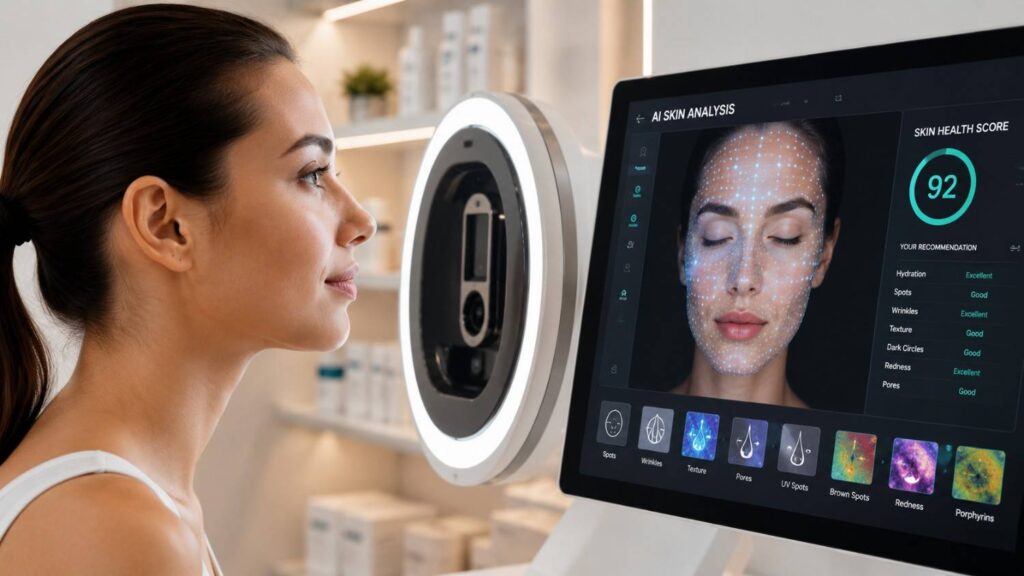
The Future of Skincare: AI-Based Skin Analysis
The Future of Skincare: AI-Based Skin Analysis is likely to be shaped by a shift from one-size-fits-all beauty recommendations toward more measurable and individualized skin assessment. Rather than selecting a routine solely from a broad category such as “dry,” “oily,” or “combination,” future systems may use images and longitudinal data to describe specific visible concerns and how those concerns change over time.
That possibility is already becoming technically realistic. In a 2025 study, researchers demonstrated that machine learning could simultaneously estimate Fitzpatrick skin type, pigmentation, redness, and wrinkle severity from ordinary facial photographs. The results were promising, but they also showed that performance differed across individual skin characteristics and levels of severity.
The broader field is moving toward more complex models as well. A 2026 dermatology review argues that clinically useful artificial intelligence will need to incorporate multiple kinds of information instead of relying on photographs alone.
For skincare, this could eventually mean systems that combine standardized facial images with routine history, previous scans, user-reported sensitivity, treatment history, environmental exposure, and professional observations.
However, progress introduces new responsibilities. AI systems need to perform reliably across different skin tones. They need to communicate uncertainty instead of presenting every output as a fact. They need clear privacy policies because facial images and health-related information can be sensitive data.
The future is therefore not simply “AI will analyze everyone’s skin.” A more realistic future is AI becoming one layer in a larger skincare decision-making system, where technology provides measurement and pattern recognition while qualified humans remain responsible for context, judgment, and medical care.
How Does AI-Based Skin Analysis Work?
AI-based skin analysis generally begins with a digital image. A user may take a selfie with a smartphone, stand in front of a dedicated imaging device, or have photographs captured in a clinic under more controlled lighting. Computer-vision software then identifies the relevant facial or skin regions and processes the visual information according to the model’s intended task.
Machine learning depends on examples. During development, a model is shown images with labels or measurements that represent what developers want it to learn. Those labels may come from dermatologists, trained evaluators, instruments, pathology results, or other reference standards depending on the purpose of the system.
For cosmetic analysis, a model might learn to associate image patterns with graded wrinkle severity, visible redness, pigmentation, or another surface feature. A 2025 facial-analysis study, for example, used thousands of dermatologist-labeled images across multiple skin scales to train models capable of predicting several facial characteristics simultaneously.
The final score is therefore not the result of an AI “looking at skin like a person.” It is a computational prediction based on relationships learned from training data.
This explains why data quality matters so much. If a model has seen limited examples of particular skin tones, conditions, image qualities, or environments, it may perform less reliably when those situations appear in real use.
FDA researchers make the same broader point for AI-enabled medical devices: changes in input data, acquisition systems, clinical populations, and environments can alter model performance after development.
Understanding this process helps consumers evaluate AI more realistically. A polished interface may look simple, but the quality of the result depends on the data, labeling, validation, and intended use behind it.
From Selfie to Skin Score
A consumer AI skincare experience often begins with a guided facial photograph. The app may ask the user to remove makeup, face natural or even lighting, keep the camera at a particular distance, or position the face within an on-screen outline.
The software can then locate areas such as the forehead, cheeks, nose, chin, or eye region and analyze visual patterns associated with the concerns it supports. The result may appear as a score, map, percentage, category, or set of highlighted facial regions.
What looks like a simple “scan” can involve several computational stages. The system may first detect the face, standardize image dimensions, correct or normalize parts of the image, segment relevant skin areas, and then apply a trained prediction model.
The quality of the original photograph remains important. Smartphone cameras differ in sensors, lenses, automatic exposure, sharpening, color processing, and software. Lighting can also change the apparent intensity of pigmentation and redness.
Real-world dermatology research illustrates why this matters. A 2025 systematic review found that AI skin-lesion diagnostic performance was lower in smartphone environments than in specialist settings, demonstrating that results obtained under controlled conditions do not always transfer perfectly to everyday images.
For cosmetic tracking, standardized photography may therefore be more valuable than taking random selfies under different conditions. The more consistent the images, the more meaningful repeated comparisons can become.
| AI Analysis Area | Technology Used | What It Evaluates | Main Use |
|---|---|---|---|
| Wrinkle Analysis | Computer vision + machine learning | Fine lines and wrinkle severity | Cosmetic assessment |
| Pigmentation Analysis | Facial imaging + image processing | Visible pigmentation and uneven tone | Skin monitoring |
| Redness Detection | Image analysis + pattern recognition | Visible redness variations | Progress tracking |
| Pore Analysis | Computer vision | Pore visibility and distribution | Texture assessment |
| Skin Tone Classification | Image recognition models | Skin tone characteristics | Personalization |
| Texture Assessment | Facial imaging + machine learning | Visible surface irregularities | Skincare monitoring |
| Longitudinal Tracking | Image comparison + AI scoring | Changes across multiple images | Before-and-after evaluation |
Cosmetic Analysis Is Different From Diagnosis
Cosmetic skin analysis and medical diagnosis may use some of the same technologies, but they serve very different purposes.
A cosmetic tool might say that a photograph contains visible redness, uneven pigmentation, wrinkles, or enlarged-looking pores. Those observations can help organize aesthetic concerns. They do not automatically identify the biological or medical cause behind the appearance.
For example, visible redness could be associated with temporary irritation, environmental exposure, acne inflammation, rosacea, dermatitis, or other possibilities. Determining the correct explanation may require symptoms, history, physical examination, lesion distribution, medication information, dermoscopy, laboratory testing, biopsy, or response to previous treatment.
A 2026 review emphasizes exactly this point, arguing that dermatology AI needs to move beyond isolated image classification because clinical diagnosis depends on multimodal information.
Regulatory context also matters. FDA’s AI-enabled medical-device list contains products that have met applicable premarket requirements for defined medical purposes. FDA also has a specific product classification for software-aided skin-lesion diagnostic devices intended for physician use, where the software acts as an adjunctive second read rather than a standalone diagnosis.
That is a much different standard from a beauty app recommending a moisturizer.
Consumers should therefore ask what the tool is actually claiming. If the output crosses from cosmetic guidance into diagnosis or treatment of disease, the evidence and regulatory expectations become much more important.
Where AI Is Changing Skincare Today
AI is already influencing skincare in several practical ways, although not every application carries the same level of evidence. The most mature consumer use cases involve image analysis, recommendation systems, digital consultations, and progress tracking rather than fully autonomous medical diagnosis.
In a typical cosmetic workflow, an AI platform might evaluate a facial image and organize the results into categories such as wrinkles, pigmentation, redness, texture, or pores. The system can then connect those categories with educational information or product recommendations.
Professional aesthetic settings may use more controlled photography or dedicated imaging devices to document visible concerns before treatment and compare changes afterward. Reviews of AI in aesthetic and cosmetic dermatology describe growing interest in objective assessment, treatment planning, patient education, and image-based monitoring while also emphasizing that many applications still require stronger validation and evidence of improved clinical outcomes.
AI can also support digital consultations by organizing information before a user speaks with a human professional. Instead of beginning with only “my skin feels different,” a platform might present a structured history of images, user-reported concerns, and changes over several months.The most useful distinction is between automation and augmentation.Automation means the system performs a repetitive task, such as scoring the same visible feature across many images. Augmentation means the system helps a person make a better-informed decision.
For a broader look at how AI skin imaging is shaping modern skincare assessment, this overview provides useful context on the technology and its practical applications.
The second approach is likely to be more important in professional skincare. AI can provide measurements and organization, while a dermatologist, aesthetic clinician, or experienced skincare professional considers medical history, tolerability, lifestyle, goals, and risk.That collaborative model offers personalization without assuming that an algorithm can understand the full context of an individual face from pixels alone.
More Personalized Skincare Recommendations
Traditional skincare recommendations often begin with broad categories: dry skin, oily skin, combination skin, acne-prone skin, sensitive skin, or mature skin. Those categories can be useful, but they sometimes oversimplify what an individual actually experiences.
AI offers the possibility of more granular personalization. A system might combine visible pigmentation, redness, wrinkle patterns, or texture-related features with a questionnaire about current products, sensitivity, climate, lifestyle, treatment history, and goals.The result could be a more structured routine than a generic product quiz.However, the recommendation layer deserves as much scrutiny as the image analysis itself.
An AI system may be excellent at identifying visible pigmentation while having weak evidence for the products it recommends afterward. Detection and recommendation are separate tasks. The first asks, “What visual feature is present?” The second asks, “What intervention is appropriate for this person?”
A responsible platform should therefore explain the logic behind recommendations and avoid overstating certainty. It should also identify circumstances where a cosmetic suggestion is inappropriate—for example, when symptoms indicate that professional medical evaluation may be needed.
The future may also involve routines that adapt over time rather than remaining static. If standardized scans show no improvement, the platform might prompt a review. If irritation appears to increase, it might recommend simplifying the routine or consulting a professional rather than automatically adding more active ingredients.That kind of personalization would be more valuable than simply producing a longer shopping list.
Better Progress Tracking
Progress tracking may ultimately be one of the most useful and least controversial applications of AI skincare technology.Human memory is not particularly reliable for subtle visual changes. A person may believe their pigmentation is dramatically better or worse than it was three months earlier, but memory is influenced by mood, lighting, recent photographs, and expectations.Standardized images create a more consistent reference point.
AI can potentially measure the same visible feature repeatedly and display a trend over time. A user might see that wrinkle severity remains stable, visible redness fluctuates, or pigmentation gradually changes across several months.The 2025 facial-analysis study demonstrates that machine-learning systems can quantify multiple visible characteristics from color photographs, supporting the basic technical feasibility of repeated feature scoring.The challenge is avoiding false precision.
A score changing from 62 to 65 does not necessarily mean the skin biologically changed by a meaningful amount. Lighting, camera position, focus, facial expression, hydration, makeup, and device processing can influence photographs.Future systems should therefore emphasize trends and confidence, not dramatic interpretations of tiny day-to-day differences.I would also expect stronger platforms to encourage standardized capture conditions: similar lighting, camera distance, time of day, facial position, and no makeup when appropriate.
When those variables are controlled, longitudinal analysis can become a useful complement to subjective impressions. It can support conversations about whether a routine or professional treatment appears to be producing visible change without pretending that an image score captures every aspect of skin health.
Related Articles
What Are the Biggest Benefits of AI Skincare Technology?
The most realistic benefits of AI skincare come from measurement, scale, accessibility, and organization.A trained model can apply the same scoring process repeatedly across thousands of images. That consistency may help reduce some of the variability that occurs when visible features are assessed informally from memory or by different observers.
AI can also bring forms of image analysis into environments where dedicated imaging equipment is not available. Smartphone-based systems have the potential to support home documentation, remote consultations, consumer education, and progress tracking between professional appointments.However, convenience should not be confused with guaranteed accuracy.
A 2025 meta-analysis of AI skin-lesion diagnostic systems found that performance was highest in specialist environments and lower in community and smartphone settings. It also found lower diagnostic performance in darker Fitzpatrick skin-tone groups than lighter groups.Those results come from medical lesion analysis rather than ordinary cosmetic scoring, but the broader lesson applies: real-world context matters.
AI also has a potential role in creating better records. Instead of one isolated consultation, a professional could review a sequence of standardized images and structured measurements. That timeline may make it easier to discuss treatment response, seasonal variation, or whether a visible concern is actually changing.
The table below summarizes the benefits without separating them from their limitations.
| Potential Benefit | What AI Can Contribute | Important Limitation |
|---|---|---|
| Personalization | Organize visible skin concerns | Recommendations still need evidence |
| Progress tracking | Compare repeated images | Lighting and camera differences matter |
| Accessibility | Bring analysis to smartphones | Consumer-image performance may be lower |
| Consistency | Apply the same scoring framework repeatedly | Biased training data can create biased outputs |
| Professional support | Assist measurement and documentation | AI should not replace clinical judgment |
The most valuable AI will therefore be technology that helps users and professionals make better-informed decisions, rather than technology that simply generates more scores.
Consistency and Accessibility
Consistency is one of AI’s most attractive characteristics. Once a system has been defined, it can apply the same computational procedure repeatedly rather than changing its standards from one day to the next.
That could be especially valuable for longitudinal cosmetic assessment. A wrinkle-scoring algorithm, for example, can evaluate a defined region using the same model each time. A human observer may unconsciously change how severely they judge the feature depending on lighting, expectations, or prior knowledge.
Accessibility is equally important.
Smartphone cameras allow skin images to be captured almost anywhere, potentially expanding access to digital education, remote monitoring, and pre-consultation tools. People living far from specialist clinics may also benefit from technologies that help organize information before a teledermatology or professional appointment.
The limitation is that uncontrolled images are harder to interpret reliably.
The 2025 skin-lesion meta-analysis found specialist-setting AI performance exceeded performance in smartphone environments. The pooled AUROC reported in that review was approximately 0.90 in specialist settings versus 0.81 in smartphone settings.
Those figures should not be transferred directly to cosmetic apps, but they illustrate an important principle: image quality and deployment setting affect AI performance.
Future consumer systems can reduce this problem through guided image capture, automatic quality checks, lighting warnings, repeated photographs, and refusing to score an image when conditions are inadequate.
That final behavior may be particularly important. A system that sometimes says “I cannot analyze this image reliably” can be more trustworthy than one that always generates an impressive-looking number.
Data-Driven Conversations With Professionals
AI can make consultations more informative when it organizes data rather than attempting to replace professional judgment.
Imagine a patient returning to an aesthetic clinic six months after beginning a pigmentation treatment. Instead of relying only on memory and two photographs selected manually, the clinician could review standardized images collected at several points, along with automated measurements and notes about product use or treatment dates.
That information could improve the quality of the discussion even if the clinician does not accept every AI-generated score as definitive.
The same principle can apply to teledermatology and digital-health workflows. The American Academy of Dermatology recognizes that digital health can improve access, while also making clear that technology cannot always substitute for an in-person examination.
The future may therefore involve AI functioning as an information organizer.
A platform could summarize trends, identify images that changed significantly, remind the user which treatments were started between scans, and present structured questions for a professional consultation.
That approach is more valuable than an app confidently declaring that it has “diagnosed” a person’s skin from one selfie.
It also creates opportunities for better patient education. A dermatologist or aesthetic professional can explain why an algorithm’s visible redness score does not automatically indicate rosacea, or why a pigmentation change needs interpretation within the patient’s medical and treatment history.
AI then becomes part of a shared decision-making process. It supplies measurements and patterns; the professional supplies context, judgment, examination, and responsibility.
What Are the Risks and Limitations of AI Skin Analysis?
AI skincare has genuine potential, but the limitations are not minor technical footnotes. They determine whether the technology can be trusted.The first challenge is generalizability. A model that performs well on the images used during development may perform differently when exposed to other cameras, lighting conditions, age groups, skin tones, regions, or clinical environments.
FDA researchers specifically identify changes in data acquisition and patient populations as factors that can alter the performance of AI-enabled medical devices after development.
The second challenge is fairness.
A 2025 systematic review and meta-analysis of AI skin-lesion diagnosis found lower performance for Fitzpatrick skin types IV–VI than for types I–III. It also found reduced performance in smartphone environments compared with specialist settings.The third challenge is privacy. A facial image can be uniquely identifying, and a skincare platform may combine it with information about skin concerns, medications, routines, age, location, or health history.
FTC guidance makes clear that many health-related apps may have privacy and breach-notification obligations even when HIPAA does not apply.Finally, there is the risk of overconfidence.
Consumers can easily interpret a polished score as objective truth. A useful system should communicate uncertainty, define its intended use, and recognize situations where it should stop providing cosmetic guidance.The best future AI may therefore be distinguished less by how many conclusions it produces and more by how responsibly it handles uncertainty.
Skin-Tone Bias Must Be Addressed
Skin-tone bias is one of the most important challenges in dermatology AI because visual information changes across different levels of pigmentation.Certain findings, including erythema or changes in color, may look different on darker skin than on lighter skin. If training datasets contain disproportionately more images from lighter skin tones, models may learn patterns that generalize poorly to underrepresented users.Current evidence shows this problem is not theoretical.
A 2025 systematic review and meta-analysis covering more than 70,000 skin-lesion test images found a pooled AUROC of approximately 0.89 in lighter Fitzpatrick skin types I–III compared with 0.82 in darker types IV–VI.
Those numbers concern lesion diagnosis rather than cosmetic wrinkle or pore analysis, so they should not be treated as universal AI skincare accuracy figures. They do, however, demonstrate the need for subgroup testing.The solution requires more than simply collecting “diverse images.”
Developers need sufficiently large datasets across skin tones, ages, sexes, ethnicities, image devices, geographic populations, and relevant conditions. They also need to report performance by subgroup rather than hiding differences inside one overall accuracy number.For beauty technology, this is especially important because the promise is personalization.
A system cannot credibly call itself highly personalized if users with certain skin tones receive systematically less reliable analysis.Consumers and professionals should therefore look for transparent validation across diverse populations rather than relying on inclusive marketing photographs alone.
Privacy Matters When Your Face Becomes Data
AI skincare often requires users to upload some of their most personal digital information: close facial photographs.
Those images may be combined with age, skin concerns, treatment history, product use, allergies, location, account information, or health-related answers. Depending on how a service operates, the resulting dataset may be highly sensitive.
It is also important to understand that HIPAA does not automatically cover every health or beauty app.
FTC guidance explains that many organizations collecting health-related information fall outside HIPAA but may still be subject to the FTC Act and, in some situations, the FTC’s Health Breach Notification Rule. Amendments effective in 2024 clarified the rule’s application to many health apps and similar technologies.
Before uploading facial images, users should review more than the permission screen.
I recommend checking whether the privacy policy explains how long images are retained, whether raw photographs can be deleted, whether information is shared with analytics or advertising partners, whether images may be used to train AI models, and what happens after an account is closed.
The company should also explain how data is secured and what happens in the event of a breach.
Professional skincare businesses using third-party AI tools should ask the same questions before uploading client photographs. Convenience does not remove responsibility for protecting sensitive information.
As AI personalization becomes more sophisticated, privacy should become part of the product’s value proposition—not something hidden in legal text after the user has already uploaded their face.
AI Should Know When to Stop
One of the most important features of a trustworthy AI system is the ability to decline to give an answer.Consumer technology often rewards confidence. Users expect a score immediately, so platforms may be tempted to analyze every photograph regardless of lighting, image quality, unusual findings, or whether the concern falls outside the system’s intended purpose.That is not necessarily good AI design.
A safer system should detect inadequate images and request a better photograph. It should communicate low confidence when a result is uncertain. Most importantly, it should recognize when the user’s concern may require medical evaluation rather than cosmetic recommendations.The American Academy of Dermatology advises consumers not to rely on diagnostic apps to determine skin diseases because inaccurate information can delay appropriate care.
The FDA’s classification of some AI-assisted skin-lesion technologies also illustrates the importance of limits. One current product category is explicitly described as an adjunctive second-read tool for physicians rather than a standalone diagnostic system.Consumer skincare technology should adopt the same general humility.
If a user reports a rapidly changing mole, persistent bleeding, severe rash, infection symptoms, or another medically concerning issue, the AI should not continue recommending cosmetic ingredients as if the problem were simply texture or redness.Knowing when to escalate is part of intelligence.In the long term, systems that communicate uncertainty clearly may earn more trust than those that claim to understand every image.
What Will the Future of AI-Powered Skincare Look Like?
The next generation of AI skincare will likely move beyond the one-time “take a selfie and receive a score” model.
A more useful system would build a longitudinal skin profile. It could compare standardized images over months, record when routines or professional treatments changed, and distinguish stable patterns from short-term fluctuations.Future platforms may also become increasingly multimodal.
Instead of analyzing photographs alone, they could combine imaging with questionnaires, previous scans, environmental information, treatment history, sensor data, or professional notes. In medical dermatology, researchers are already arguing that multimodal reasoning is necessary because real diagnosis depends on information far beyond a single image.Cosmetic skincare can benefit from the same insight without pretending to become medicine.
The growing role of AI-powered skincare is also reflected in emerging approaches that combine digital analysis with more personalized beauty and skincare experiences.
A person with visible dryness-related texture, for example, could receive different guidance depending on whether they report starting a retinoid, traveling to a dry climate, undergoing a peel, or developing burning and persistent irritation.
AI may also become more integrated into professional workflows. Instead of replacing consultations, it could prepare information beforehand, measure standardized features during appointments, and monitor changes afterward.Regulation and transparency will become more important as these systems become more influential.
The FDA continues to refine its approach to AI-enabled medical devices, including lifecycle monitoring, performance evaluation, transparency, and management of model changes.The skincare industry can learn from those principles even when products are not medical devices.The most credible future is one where AI becomes less of a novelty score and more of a transparent, validated layer of measurement supporting better decisions.
| Future Development | Current Challenge | Expected Improvement | Key Requirement |
|---|---|---|---|
| Longitudinal Skin Profiles | One-time image assessments | Track visible changes over weeks or months | Consistent imaging |
| Multimodal Analysis | Reliance on photographs | Combine images with additional context | High-quality datasets |
| Diverse AI Training | Underrepresentation of darker skin tones | More equitable performance | Representative training data |
| Smartphone Optimization | Variable camera and lighting conditions | More reliable consumer analysis | Real-world validation |
| Personalized Recommendations | Generic skincare suggestions | More individualized guidance | Evidence-based algorithms |
| Privacy-Centered AI | Facial and health data concerns | Greater user control over personal data | Transparent data policies |
| Human-AI Collaboration | Risk of overreliance on automated results | Better professional decision support | Clinical oversight |
| Confidence & Escalation Systems | AI may overstate uncertain findings | Clear uncertainty and referral pathways | Robust validation |
From One-Time Scans to Longitudinal Skin Profiles
A one-time scan gives a snapshot. A longitudinal profile can potentially show a pattern.This distinction may change how consumers evaluate skincare.At present, people often switch products based on impressions formed over a few days. They may interpret temporary dryness, lighting differences, hormonal changes, or one flattering photograph as evidence that a routine is working or failing.A well-designed AI system could make evaluation more structured by comparing standardized images collected over longer periods.
Instead of one global “skin age” number, the profile might display separate trends for wrinkles, pigmentation, visible redness, or another supported feature.The 2025 machine-learning study on facial photographs demonstrates that multiple characteristics can already be estimated from color images, creating a technical foundation for repeated measurement.However, longitudinal tracking requires strict attention to consistency.
If the first photograph is taken beside a bright window and the second under warm bathroom lighting, a difference in pigmentation or redness may reflect photography rather than skin.
Future apps can improve reliability by automatically checking lighting, camera distance, head angle, focus, makeup, and facial expression before accepting a scan.They may also use multiple images rather than one photograph to reduce noise.The goal should not be to make users inspect microscopic changes every morning. That could encourage unnecessary anxiety and product switching.A better model would summarize meaningful trends over weeks or months and help users decide when to continue a routine, simplify it, or seek professional input.
Human-AI Collaboration Will Matter Most
The strongest future for AI skincare is probably not an app replacing dermatologists, estheticians, cosmetic chemists, or experienced skincare professionals.
It is a system that allows each participant to do what they do best.AI can process large amounts of visual information consistently, compare current images with previous scans, calculate measurements, identify patterns, and organize data before a consultation.
A trained professional can interpret those findings within the context of medical history, symptoms, medications, allergies, procedures, treatment goals, skin behavior, and physical examination.
This collaborative model is consistent with the direction of medical AI regulation. FDA’s current AI-enabled medical-device framework emphasizes defined intended uses, appropriate premarket evaluation, safety, effectiveness, and continued monitoring rather than assuming an AI output is inherently trustworthy because it was generated by a sophisticated model.Human oversight is especially important when cosmetic and medical concerns overlap.
A pigmentation-analysis tool might document uneven tone effectively. A dermatologist may still need to determine whether a particular pigmented lesion requires examination.Similarly, AI might quantify visible redness while a clinician identifies rosacea, dermatitis, infection, or another cause.The future therefore should not be framed as AI versus experts.It is more useful to ask which tasks benefit from automation and which require judgment.When that division is designed carefully, AI can reduce repetitive measurement, improve documentation, and make consultations more data-rich without removing the human expertise needed for safe interpretation.
Quick Answer About The Future of Skincare: AI-Based Skin Analysis
The future of skincare is likely to include AI systems that analyze standardized facial images, identify selected visible skin features, track changes over time, and combine those observations with information about a person’s routine, preferences, sensitivity, treatments, or environment. This could make cosmetic skincare recommendations more personalized and make progress easier to document.
AI is already capable of estimating certain visible characteristics from facial photographs. Research published in 2025 showed that a machine-learning system trained on thousands of labeled images could assess Fitzpatrick skin type, hyperpigmentation, redness, and wrinkle severity simultaneously.
However, AI skin analysis should not automatically be treated as a medical diagnosis. The American Academy of Dermatology warns that apps attempting to diagnose skin diseases can provide inaccurate information and recommends professional evaluation when a diagnosis or treatment plan is needed.
The strongest future model is therefore likely to be AI plus human expertise. Artificial intelligence can measure, organize, compare, and flag patterns. Consumers, skincare professionals, and dermatologists can then interpret those findings within the appropriate cosmetic or medical context.
What can AI skin analysis measure?
The exact answer depends on how the system was designed, what images it was trained on, and which features its developers chose to label. Current research demonstrates that computer vision can estimate several visible facial characteristics rather than simply producing a single generic “skin score.”
A 2025 Journal of Cosmetic Dermatology study used 3,662 facial images labeled by a dermatologist across multiple skin scales. The researchers trained models to predict Fitzpatrick skin type, hyperpigmentation, redness, and wrinkle severity simultaneously. Their best-performing model achieved a mean test-set accuracy of about 85% across the labels, but performance varied according to the characteristic being assessed and was stronger at some ends of the scoring scales than in the middle.
Other cosmetic systems may attempt to evaluate visible pores, texture, fine lines, or changes in apparent tone. The key point is that each result should be understood as a measurement produced for a particular feature under particular conditions.
A useful AI tool should therefore explain what it is measuring, how that measurement was validated, and what the score actually means. A wrinkle estimate is not the same as a diagnosis, and a redness score does not determine whether the underlying cause is irritation, rosacea, dermatitis, sun exposure, or something else.
Can AI replace a dermatologist?
AI can support parts of dermatologic assessment, but current evidence does not justify treating a consumer AI system as a complete replacement for a dermatologist. Dermatologic diagnosis requires information that frequently goes far beyond a photograph.
A 2026 review of AI-assisted dermatology explains that clinicians consider morphology, distribution, symptoms, tactile findings, temporal evolution, patient history, histopathology, and treatment response. The authors argue that the field needs to move beyond simple single-image classification toward multimodal clinical reasoning.
This limitation matters because different skin conditions can look similar in one photograph. The same visible redness, scaling, pigmentation, or bump can have multiple possible causes that require different management.
The American Academy of Dermatology also warns consumers that apps attempting to diagnose skin diseases or generate treatment plans may provide inaccurate information. Its guidance recommends seeing a board-certified dermatologist for diagnosis rather than deciding among algorithm-generated possibilities yourself.
AI is therefore better viewed as an assistant. It can potentially organize images, measure selected features, identify changes, or support a clinician’s workflow. The final medical interpretation should remain grounded in professional assessment whenever disease, suspicious lesions, persistent symptoms, prescription treatment, or uncertain findings are involved.
Frequently Asked Questions About The Future of Skincare: AI-Based Skin Analysis
Questions about The Future of Skincare: AI-Based Skin Analysis often sound simple but involve several different technologies. A consumer selfie analyzer, an aesthetic-clinic imaging platform, and an FDA-authorized medical device may all use artificial intelligence, yet they are not equivalent.
The safest way to evaluate a tool is to begin with its intended purpose.
If it claims to help track cosmetic features such as wrinkles, pigmentation, or visible redness, ask how those measurements were validated and whether performance was tested across diverse users.
If it claims to diagnose disease, the standard should be much higher. FDA regulates certain AI-enabled products as medical devices, while the American Academy of Dermatology continues to caution against relying on unvalidated consumer diagnostic apps.
Users should also remember that AI performance is not fixed across every environment. Research has documented lower dermatology-AI performance in smartphone settings and darker skin-tone groups, which means real-world reliability should be evaluated rather than assumed.
Privacy belongs in the same conversation. Uploading a face can involve sensitive personal data, particularly when the image is connected with symptoms, medical information, treatments, or identifiers.
The questions below therefore focus not only on what AI can do, but also on how consumers can interpret its outputs responsibly.
Can AI really analyze your skin from a selfie?
Yes, AI can analyze selected visible characteristics from an ordinary facial photograph, although the quality and meaning of the output depend on the specific system.
A 2025 study trained machine-learning models using 3,662 facial images labeled by a dermatologist. The best model simultaneously predicted Fitzpatrick skin type, pigmentation, redness, and wrinkle severity with promising overall performance.That demonstrates that a standard color image can contain enough information for algorithms to estimate certain visible features.However, a selfie is not a standardized medical examination.
Lighting, camera processing, focus, makeup, facial expression, distance, and device quality can change how the skin appears. A system designed for consumer use should ideally guide the user through consistent image capture and reject images that are not suitable for analysis.
It is also important to separate visible-feature scoring from diagnosis.An AI may identify that an area appears redder than surrounding skin. That does not establish why the redness exists.For everyday cosmetic tracking, selfie-based analysis can therefore be useful when the tool has a clearly defined purpose and realistic claims.For new, persistent, painful, changing, or medically concerning skin findings, a professional assessment remains more appropriate than relying on a cosmetic selfie analysis.
Is AI skin analysis accurate?
There is no single accuracy percentage that applies to “AI skin analysis.”
Accuracy depends on the task being measured, the model architecture, the training data, reference labels, population, imaging environment, and definition of a correct result.
In the 2025 facial-feature study, the best model achieved a mean test accuracy of approximately 85% across its supported labels and a mean AUROC of about 0.83, but performance differed between individual characteristics and severity levels.
That result belongs to one research system. It should not be used as the accuracy claim for every consumer skincare app.
Medical dermatology research shows similar variability. A 2025 meta-analysis of AI skin-lesion diagnosis found pooled performance was stronger in specialist settings than smartphone environments and lower on darker skin-tone groups than lighter groups.Consumers should therefore ask more specific questions.What exactly has the system been validated to measure? Was the test dataset independent from the training data? Were different skin tones included? Does the company report subgroup results? What happens when image quality is poor?
A trustworthy platform should answer those questions instead of relying on a vague statement such as “powered by advanced artificial intelligence.”Accuracy is meaningful only when attached to a clearly defined task and population.
Can AI recommend the right skincare routine?
AI can help personalize a skincare routine, but the quality of the final recommendation depends on more than the accuracy of the facial analysis.Imagine that an algorithm correctly identifies visible pigmentation. The next question is not simply which product is marketed for “brightening.” The appropriate routine can depend on sensitivity, pregnancy status, medications, current actives, history of irritation, underlying skin conditions, sun exposure, previous procedures, and the type of pigmentation involved.Those factors may not be visible in a photograph.
A more credible personalization system should therefore combine image analysis with structured questions rather than allowing the image score to make every decision.It should also distinguish between cosmetic education and medical treatment.
For example, an app may reasonably explain that consistent sun protection is important when managing visible photoaging or pigmentation concerns. It should be more cautious about presenting prescription-level treatment advice or attempting to diagnose the cause of discoloration.The recommendation engine should also be evidence-based.A sophisticated AI score does not make a poorly supported product claim scientifically stronger.The best future systems will likely tell users why a product category or routine step is being suggested, what limitation applies, and when professional advice would be more appropriate.Personalization should reduce unnecessary products, not simply create a more technologically impressive sales funnel.
Can AI diagnose acne, eczema, or skin cancer?
Consumer AI should not be treated as a substitute for professional diagnosis of acne, eczema, skin cancer, or other dermatologic diseases unless a specific product has an appropriate medical intended use and supporting regulatory and clinical evidence.
The American Academy of Dermatology warns that skin-diagnosis apps can provide inaccurate information and that incorrect diagnoses may delay appropriate treatment. It recommends seeing a board-certified dermatologist when diagnosis is needed.The distinction is particularly important for suspicious lesions.
FDA does regulate certain AI-enabled medical devices, and one current classification covers software that assists physicians in evaluating lesions suspicious for skin cancer. Even that classification describes the technology as an adjunctive second-read tool and states that it is not intended as a standalone diagnostic.
That illustrates how carefully medical AI is scoped.A cosmetic app identifying “redness” is performing a different function from a medical device evaluating a lesion.If a skin concern is rapidly changing, bleeding, painful, persistent, infected, or otherwise worrying, the safest response is not to repeat the scan until the app produces a reassuring answer.AI may eventually strengthen screening, documentation, and clinical decision support. Medical responsibility, however, requires more than a consumer-facing probability score.
Does AI skin analysis work equally well for every skin tone?
Current evidence suggests that equal performance across skin tones cannot be assumed.
A 2025 systematic review and meta-analysis of AI-based skin-lesion diagnosis found that pooled diagnostic performance was lower for darker Fitzpatrick skin types IV–VI than for lighter types I–III. The reported AUROC was approximately 0.82 for darker skin-tone groups and 0.89 for lighter groups.Those results relate to lesion diagnosis rather than every form of cosmetic skin analysis, but they demonstrate the broader fairness challenge.
Algorithms learn from training data. If certain skin tones, conditions, or image environments are underrepresented, the model may perform less reliably for those users.Some visual features are also inherently harder to assess across different pigmentation levels. Erythema, for example, may appear differently on darker skin.Developers should therefore test performance separately across representative skin-tone groups, not merely include a few diverse faces in the dataset.
Consumers should look for transparency about dataset composition and subgroup performance whenever possible.The long-term solution is not one universal “bias correction” setting. It requires better datasets, improved imaging methods, careful labeling, external validation, and ongoing monitoring.A personalized skincare system should be judged partly by how well it performs for people who were historically underrepresented in dermatology datasets.
Is my facial skin data private?
Your facial skin data is not automatically private simply because it comes from a health, wellness, or beauty application.
The level of protection depends on the company, the type of information collected, applicable laws, security practices, and the agreements you accept.Many consumers assume HIPAA protects every piece of digital health information. That is not the case. FTC guidance explains that many health apps and connected technologies may fall outside HIPAA while still being subject to the FTC Act and, in certain circumstances, the Health Breach Notification Rule.
The FTC’s 2024 amendments to the Health Breach Notification Rule clarified its application to many health apps and similar technologies.Before uploading a facial image, check what the company collects and why.Look for clear answers about retention periods, account deletion, image deletion, third-party sharing, advertising, analytics, AI training, security, and breach notifications.
If the service uses uploaded photographs to train future models, that practice should be understandable rather than hidden in vague language.Professional clinics should conduct similar due diligence before integrating a third-party AI platform into client workflows.A useful skin-analysis service should treat privacy as part of product quality. Users should not have to trade permanent control of sensitive facial or health-related data for a temporary skincare score.
7. Conclusion
AI-based skin analysis is moving skincare toward a more measurable and data-driven model, but the technology is still developing.Current research demonstrates that artificial intelligence can quantify selected visible facial characteristics from ordinary color photographs. That capability creates opportunities for personalization, progress tracking, remote documentation, professional consultation support, and more standardized aesthetic assessment.The technology’s limitations are equally important.
Image quality can influence results. Smartphone environments may reduce model performance. Training-data imbalances can produce fairness gaps across skin tones. A photograph cannot capture every factor required for dermatologic diagnosis. Sensitive facial and health information also creates significant privacy responsibilities.For these reasons, the future should not be defined by whether AI can produce more scores.
It should be defined by whether those scores are validated, interpretable, inclusive, private, and useful.The most credible systems will explain their intended purpose and limitations. They will reject poor images rather than inventing precision. They will distinguish cosmetic concerns from potentially medical findings. They will test performance across representative populations. They will allow users to understand and control how their data is used.
AI can make skincare more personalized, but good personalization still needs context.A system may recognize that visible redness is increasing. A human professional can ask why.It may quantify pigmentation. A dermatologist can determine whether a specific lesion requires examination.
It may recommend simplifying a routine. The user still needs to decide whether that advice fits their preferences, sensitivity, and treatment goals.The future is therefore best understood as technology improving the quality of skincare decisions rather than making every decision automatically.
Conclusion
The Future of Skincare: AI-Based Skin Analysis is not simply about replacing a traditional mirror with a digital one. Its real potential lies in turning visual skin information into structured data that can be compared, tracked, and interpreted more consistently.
Research has already demonstrated that machine-learning systems can estimate multiple visible facial characteristics from photographs, including pigmentation, redness, wrinkles, and skin type.Future platforms may add longitudinal tracking, standardized image capture, multimodal data, environmental context, treatment history, and professional integration.
Yet better technology will not remove the need for caution.AI systems remain highly dependent on their training data and deployment environment. Evidence from medical dermatology shows meaningful performance differences across smartphone settings and skin-tone groups.
The boundary between cosmetic analysis and medical diagnosis also needs to remain clear. The American Academy of Dermatology advises consumers against relying on unvalidated diagnostic skin apps, and FDA’s approach to AI-enabled medical devices demonstrates that medical claims require a defined intended use and appropriate safety and effectiveness review.
Privacy will become increasingly important as platforms collect larger histories of facial photographs, skin concerns, and personal information.The most successful AI skincare systems will therefore be those that combine useful measurement with responsible limits.They should help users understand change without increasing unnecessary anxiety, make recommendations without disguising marketing as diagnosis, and connect consumers with qualified professionals when technology alone is not enough.
The Best AI Will Support Better Decisions
The best AI skincare technology will not necessarily be the system with the most complicated dashboard or the largest number of scores.Its value will come from whether it helps a user make a better decision.
A useful system might show that visible pigmentation has remained stable for three months rather than encouraging the user to change products every week. It might recognize that a photograph is too dark for reliable analysis and ask for another image. It might identify a concerning change and recommend professional assessment rather than offering another cosmetic product.That approach requires careful design.FDA’s work on AI-enabled medical devices emphasizes performance monitoring, data shifts, transparency, uncertainty, and the possibility that models may behave differently as real-world inputs change.
Consumer skincare developers can learn from the same principles even when their software is not a regulated medical device.Users need to know what the system can measure, how reliable the result is, and what action—if any—the result should trigger.Good AI should reduce confusion rather than create a new layer of pseudo-scientific certainty.I expect the strongest platforms to become quieter and more useful over time. Instead of repeatedly announcing that a person’s “skin score” changed, they may highlight only meaningful trends and recommend simple actions.
The ultimate measure of success will not be how futuristic the analysis feels. It will be whether users make safer, more informed, and more sustainable skincare choices because of it.
Personalized Skincare Still Needs Human Judgment
Personalization is one of AI skincare’s strongest promises, but human judgment remains essential because skin exists within a larger personal and medical context.Two people can have similar-looking facial redness and require completely different responses. One may be experiencing temporary irritation from over-exfoliation. Another may have rosacea, dermatitis, an allergic reaction, or another condition that cannot be reliably distinguished from appearance alone.The same principle applies to pigmentation, dryness, breakouts, or texture.A recommendation engine needs information about current products, prescription medicines, pregnancy, allergies, procedures, sensitivity, medical diagnoses, lifestyle, and personal goals before many recommendations can be considered truly individualized.
A 2026 review of dermatology AI argues that meaningful clinical systems need multimodal reasoning because single images do not capture the full diagnostic process.That principle also improves cosmetic personalization.AI can contribute speed and consistency. A professional can provide context.
For routine cosmetic concerns, the technology might help identify patterns and organize options. When medical symptoms, unusual lesions, prescriptions, procedures, or persistent reactions appear, professional judgment becomes more important.This collaborative approach also reduces the risk of algorithmic over-treatment.An app should not respond to every imperfection by recommending another active ingredient or procedure.
Sometimes the most personalized recommendation is to simplify the routine, allow the barrier to recover, or obtain a dermatologist’s opinion.AI can help create a more precise skincare experience, but precision should mean better decisions for the individual, not simply more automated recommendations.